
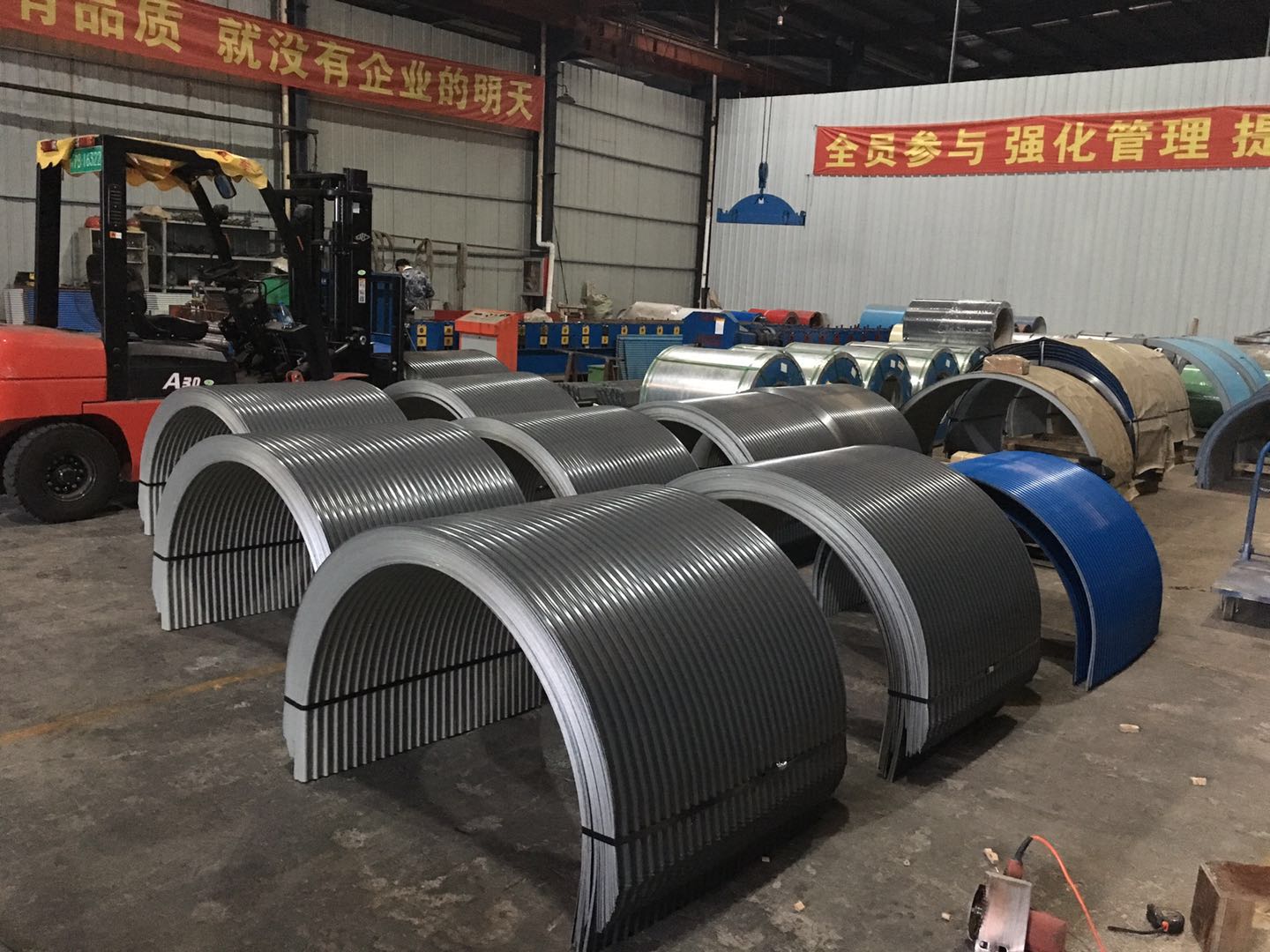
Conveyor Dust Covers:
A dust cover consists of color-coated steel sheets that are roll-formed into a corrugated profile (resembling corrugated roofing) and then shaped into a semi-circular arch. These covers are installed over belt conveyors to protect the conveyor belt and associated equipment, thereby extending the service life of the machinery, reducing maintenance costs, and improving economic efficiency. Furthermore, they prevent the dispersion of dust during material transport, thereby avoiding environmental pollution. For color-coated steel dust covers, choose Shanghai Tangyi—a manufacturer with 15 years of experience and robust technical capabilities.
Applications of Conveyor Dust Covers:
Belt conveyors are widely utilized in industries such as mining, raw material processing, and coal extraction due to their high conveying capacity, long-distance transport capabilities, simple structure, ease of maintenance, and compatibility with programmable control and automated operations. However, when belt conveyors transport dusty raw materials, significant amounts of dust are often generated at the material receiving points. This dust drifts into the air, leading to environmental pollution. As “green manufacturing” becomes the prevailing trend in industrial development, preventing the airborne dispersion of dust generated by belt conveyors has become an urgent issue requiring immediate resolution. Conveyor dust covers effectively prevent dust dispersion, thereby facilitating the realization of green manufacturing goals.
Applicable Industries for Conveyor Dust Covers:
These dust covers are utilized in major industrial and mining enterprises—including power plants, cement factories, coal mines, steelworks, and port terminals—to provide rain, dust, and wind protection for conveyor belts. By minimizing material loss during transport and extending the service life of the conveyor belts, these dust covers play a vital role in environmental purification during conveyor operation, ultimately generating significant operational cost savings for enterprises.
Manufacturing Materials: The housing of the conveyor dust cover is fabricated from coated color steel sheets. Its cross-section features a curved profile formed by the seamless connection of straight lines and circular arcs of varying radii, arranged symmetrically around a central axis. The cross-section of the housing incorporates upward-protruding reinforcing ribs spaced at regular intervals, while the edges on both sides feature outward-facing horizontal flanges for connection purposes. The complete dust cover assembly is constructed by overlapping and joining multiple individual housing sections via these side-mounted reinforcing ribs. This utility model features a rational design, robust structure, resistance to corrosion from conveyed media, anti-aging properties, and exceptional durability.
The manufacturing process for the conveyor dust cover involves feeding colored steel sheets or stainless steel sheets through a roll-forming machine to press them into straight panels featuring either fine or coarse corrugations. These formed straight panels are then passed through a bending machine to create an arched profile, thereby completing the production of the conveyor dust cover. The finished rain/dust cover features a wave pitch of 32 mm, a wave height of 9 mm, and a formed width of 920 mm; customers can utilize these specific dimensions to calculate the exact number of cover panels required for their conveyor system.
The conveyor dust cover is a product specifically designed and manufactured for belt conveyor systems. It provides effective protection for the conveyed materials against rain, wind, and dust, serving as a protective canopy for the cargo on the belt. Once installed, the dust cover effectively encapsulates the conveyor’s structural framework, leaving minimal exposed surface area.
Features of the Conveyor Dust Cover:
(1) Lightweight and High Strength: The conveyor dust cover possesses a relative density ranging between 1.5 and 2.0—approximately one-quarter to one-fifth the density of carbon steel. However, its tensile strength approaches, or even exceeds, that of carbon steel, while its specific strength (strength-to-weight ratio) is comparable to that of alloy steel. Certain epoxy-based FRP (Fiber Reinforced Polymer) materials used in these covers can achieve tensile, flexural, and compressive strengths exceeding 400 MPa. (Refer to specific material specifications for detailed density, strength, and specific strength values.)
(2) Excellent Performance: FRP is an exceptional corrosion-resistant material, demonstrating strong resistance to atmospheric elements, water, and acids, alkalis, salts, various oils, and solvents of standard concentrations. It has been widely adopted across various sectors of chemical corrosion protection, serving as a replacement for traditional materials such as carbon steel, stainless steel, timber, and non-ferrous metals.
(3) Superior Electrical Properties: It functions as an excellent electrical insulating material and is frequently utilized in the manufacture of insulators. It retains its superior dielectric properties even under high-frequency conditions. Furthermore, it exhibits excellent microwave transparency, making it widely applicable in the fabrication of radar radomes. (4) Excellent Thermal Properties
FRP possesses low thermal conductivity, making it an excellent thermal insulation material. Under conditions of transient high temperatures, it serves as an ideal material for thermal protection and ablation resistance, capable of shielding spacecraft against the scouring effects of high-velocity airflow at temperatures exceeding 2000°C.
Specifications/Models: (Matched to conveyor belt width)


